




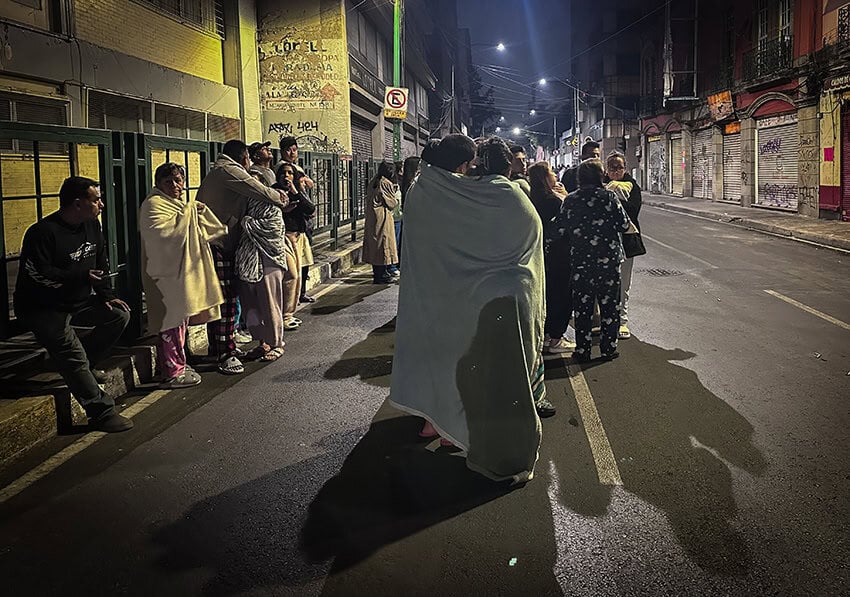
Residents of Mexico City were again rousted from their beds just after midnight Friday after an earthquake triggered the Seismic Alert System, but authorities quickly reported that no damage had occurred.
The 5.0 magnitude temblor was barely perceptible in most of the capital, but did produce some minor shaking closer to the epicenter in the Pacific coast state of Guerrero.
.@SismologicoMX: Hasta las 08:00 horas del 16/enero/2026 se han registrado 4,700 réplicas del sismo de M 6.5 ocurrido en San Marcos, Guerrero el 2/enero/2026, la más grande de magnitud M 5.0 pic.twitter.com/XS0IZzhhgn
— Webcams de México (@webcamsdemexico) January 16, 2026
In a social media post shortly after the incident, President Claudia Sheinbaum said no damage had been reported, adding that “the National Civil Protection Coordination is initiating the review protocol” in Mexico City and in areas around the epicenter.
Hours later, federal and local authorities said no injuries had been reported and confirmed that no significant damage to infrastructure had been identified.
Mexico’s National Seismological Service (SSN) described the tremor as an aftershock related to the Jan. 2 earthquake that rang in the New Year.
“Through 8 a.m. on Jan. 16, 2026, we have registered 4,700 aftershocks related to the 6.5 magnitude earthquake that occurred in San Marcos, Guerrero, on Jan. 2, 2026, the largest being magnitude 5.0,” the SSN said on its website.
Forty-eight more aftershocks occurred in the seven hours immediately after the Friday morning temblor, the largest reaching just 4.1, the SSN reported.
Newspaper reports indicated the epicenter of the 5.0 magnitude tremor was 17 kilometers (10 miles) southwest of San Marcos, and about 70 kilometers (44 miles) south of Acapulco.
The distance from San Marcos to Mexico City is roughly 365 kilometers (225 miles).
The SSN explained that the recent seismic activity in San Marcos, also near the epicenter of the Jan. 2 quake, is due to “the readjustment of the Earth’s crust after a major rupture.” Additionally, it said, “Guerrero sits at the confluence of the Cocos and North American tectonic plates, and the movements arise when the former slides under the latter, in a phenomenon known as subduction.”
Scientists have dismissed speculation that a so-called San Marcos Fault has formed, explaining that San Marcos is located very close to the Guerrero Gap, which extends approximately 150 kilometers (93 miles) from Acapulco to Papanoa-Petatlán, and is part of the Cocos-North America boundary.
Movement along the Guerrero Gap occasionally produces large earthquakes, but frequent, slow-slip events that release strain, known as silent earthquakes, are more characteristic.
With reports from El Universal, El Financiero, N+ and Infobae