Mexico City is gearing up to celebrate the 700th anniversary of Tenochtitlán, the pre-Columbian capital of the Aztec Empire, with a series of events on and around July 26 at several of the modern capital’s landmarks.
Tenochtitlán, the largest and most advanced city of its time in Mesoamerica, is thought to have been founded in 1325 by the Aztecs — more accurately known as the Mexica (Meh-shee-ca) — on an island in Lake Texcoco in the Valley of Mexico. It was the heart of a powerful multiethnic state that dominated much of Mesoamerica through alliances and conquests.
It fell on August 13, 1521, to Spanish conquistador Hernán Cortés and his Indigenous allies, marking the end of the Aztec Empire and the beginning of the colonial era. The Spanish conquerors proceeded to destroy most of what was left of Tenochtitlán as they started to build what would become Mexico City.
During President Claudia Sheinbaum’s Monday morning press conference, Diego Prieto, head of the National Institute of Anthropology and History (INAH), said that “the goal of this commemoration is to recover historical memory and recognize the greatness of those who built this city.”
Of course, the exact date of the city’s founding is not known, but Lorena Vázquez, head of INAH’s Urban Archaeology Program, explained that July 26 was chosen as a symbolic date because it marks the “second passage of the sun” in the Mesoamerican calendar.
What events are planned for the Tenochtitlán celebration?
This is the official program of the celebration, as announced by Mexico City Mayor Clara Brugada:
Video Mapping: Every night from July 11 to 27, a light and sound show will be projected onto the facades of the National Palace and the Metropolitan Cathedral in Mexico City’s Zócalo, narrating the mythical journey of the Mexica from Aztlán to the founding and evolution of Mexico-Tenochtitlán.
Island Trail: A 23-kilometer illuminated path will mark the perimeter of the ancient island of Tenochtitlán, accompanied by murals and walls so that visitors can walk and learn about the city’s history.
📸😲 ¡Brotaron nopales en Paseo de la Reforma! Estas coloridas esculturas adornan ya mismo la avenida, corre a tomarte fotos y admirar todos sus detalles: https://t.co/GiX49jgSqo pic.twitter.com/BO1fUQjmGH
— timeoutmexico (@TimeOutMexico) June 17, 2025
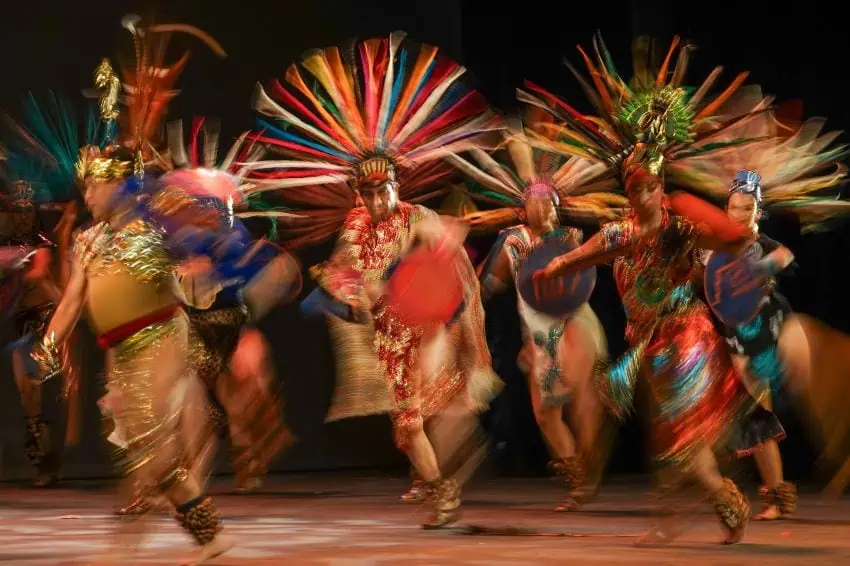
Ancestral Migration: On July 26, some 3,500 dancers from different communities will perform a symbolic tour of the capital, commemorating the migration of the Mexica people. The migration will take place from the Cincalco cave in Chapultepec Park to the capital’s Zócalo.
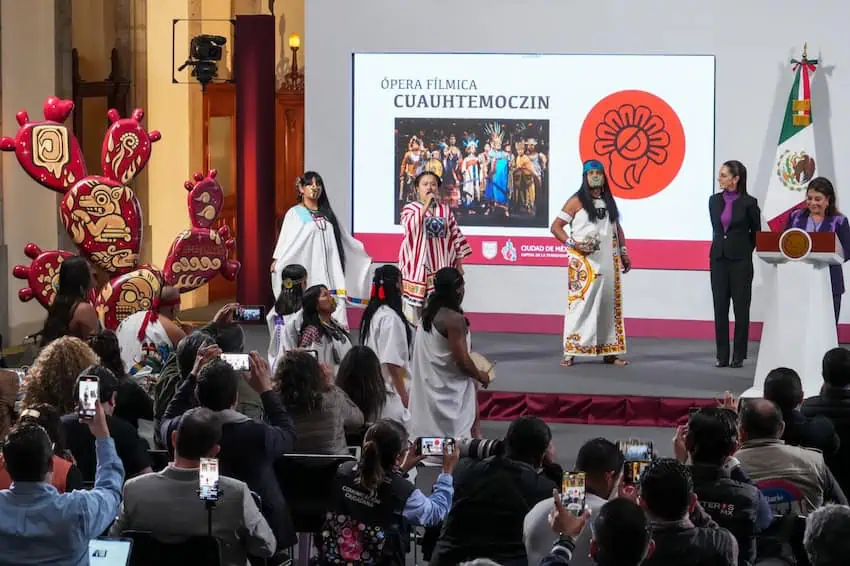
Cuauhtemoczin Film Opera: The Mexico City government will present the Cuauhtemoczin Film Opera, which narrates in Nahuatl the heroic defense of Mexico-Tenochtitlán, led by Cuauhtémoc. Several performances at the Palace of Fine Arts are to be announced.
Nopalera in the Heart: Artists and collectives from the Milpa Alta borough recently inaugurated a public art exhibition featuring 50 sculptures of nopales, the edible cactus pads that are so important to the Mexican diet. The open-air exhibit can be viewed along the Paseo de la Reforma.
Tenochtitlán Codex Book: This book will be distributed in all elementary schools in Mexico City in an effort to share the history of the Mexica migration with children.
In addition to these events, members of the Ministry of National Defense (Defensa) will perform a staged reenactment of the decisive battles of Mexico-Tenochtitlán on July 26 at 10 a.m., followed by the unveiling of a new monument later that day.
Dubbed the “Tlalmanali” (or “tlalmanalli,” the usual spelling in the Aztec language Nahuatl, “ofrenda” in Spanish, “offering” in English), the monument will be located in the northeast corner of the Zócalo, as a symbol of the Mexica legacy.
With reports from López Dóriga